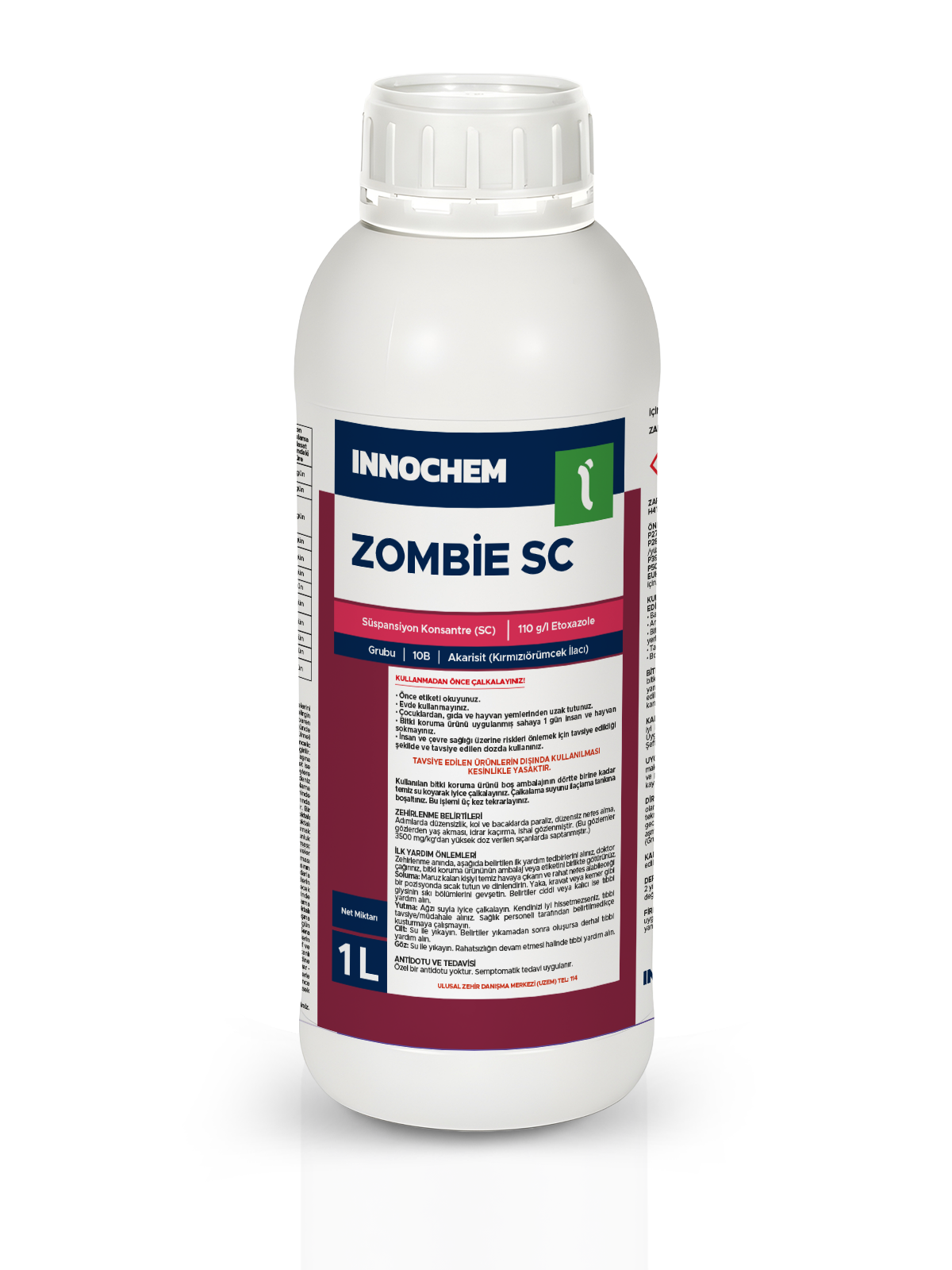
Zombie SC
Product Code: 7832
Category: Plant Protection
Product Group: ACARICIDE (Spider Mite Control)
Active Ingredient: 110 g/L Etoxazole
Formulation: Suspension Concentrate (SC)
Mode of Action Group: 10B
General Information
- Toxic to fish. Do not contaminate water.
- Toxic to bees. Do not use during flowering.
- Store the plant protection product in a cool, dry and well-ventilated place.
- Not phytotoxic when used as recommended.
- Dispose of empty product packaging properly.
Do not allow people or animals into the treated area for 1 day.
Storage: When stored unopened in the original packaging under normal (cool and dry) conditions, the physical, chemical and biological properties of the product remain within tolerance limits for 2 years.
Preparation for application: First mix the plant protection product, calculated according to the recommended dose, with some water in a separate container. Fill the sprayer tank half full with water. With the agitator running, add the mixture to the tank. Continue mixing while topping up the tank with water. Keep agitating until the application is completed. Use the prepared spray mixture on the same day.
Calibration: The sprayer must be calibrated before application. The spray volume applied to a given area must be adjusted to ensure good coverage. Applications should be made during the cool hours of the day in calm or light-wind conditions. The spray volume for peach is 50-200 l/da.
Cleaning the sprayer: Immediately after application, empty the sprayer tank safely. Fill the tank with clean water and run the agitator and spray system to rinse all parts. Do not wash equipment near water sources. Do not discharge rinse water or waste into water sources.
Compatibility: Mixing ZOMBİE SC with other plant protection products is not recommended.
“Always read the label and product information before use”
“Use plant protection products carefully”
Properties: It is a contact acaricide. It acts against the eggs, larvae and nymphs of spider mites by preventing them from moulting. It is not effective against adults. Its marked effect appears 3-5 days after application and its effect lasts about 1 month.
Apple – European red mite: From the beginning of May, in periodic counts on 100 leaves, treatment should be made when an average of 8-10 live individuals per leaf is seen. After the first application, checks should continue at 15-day intervals until the end of August, and treatment should be made if high density is observed.
Tomato, Pepper (Greenhouse) – Two-spotted spider mite: For the first count in vegetable plots, enter the field diagonally from the corners of the plots at flowering. Every 3-5 steps, mite nymphs and adults are counted on the lower and middle leaves of the plant. The number of leaves to be examined per decare is 20. Control is decided if the average number of live spider mites per leaf is 3.
Cotton – Two-spotted spider mite: Surveys start after plants have 4-6 leaves. If mites have spread from the field edge into the field and the survey shows a density of 5 two-spotted spider mites per leaf in the Mediterranean Region or 10 in the Aegean and Southeastern Anatolia Regions, a cover spray is applied.
Watermelon – Two-spotted spider mite: For the first count in vegetable plots, enter the field diagonally from the corners of the plots at flowering. Every 3-5 steps, mite nymphs and adults are counted on the lower and middle leaves of the plant. The number of leaves to be examined per decare is 10. Control is decided if the average number of live spider mites per leaf is 5.
Vineyard – Two-spotted spider mite: From May onwards, in periodic counts on 100 leaves, if the number of two-spotted spider mites exceeds an average of 8-10
individuals per leaf, treatment is required. After the first application, checks should continue at 15-day intervals until the end of August, and treatment should be made if high density is observed.
Strawberry – Two-spotted spider mite:
Early-season application: In strawberry areas where spider mites are a problem every year, one application should be made when spider mites are seen at the flowering and green fruit stage (before the first ripe fruits appear). Early-season application is safer to avoid residues on the fruit.
In-season application: Where no early-season application has been made, open-field strawberries are checked at 3-5 day intervals at the start of the season (end of March - beginning of April). At the start of the season spider mites appear on plants at the field edges; checking and treating these plants first is sufficient. If the population becomes widespread, at least 50 leaflets from the middle and lower parts of plants representative of the field are examined. Treatment is decided if 15 or more spider mites per leaflet are found. Treatment is made immediately after fruit picking. Harvest should take place observing the pre-harvest interval.
Peach, Nectarine – Two-spotted spider mite: From May onwards, in periodic counts on 100 leaves, spraying is required if the average exceeds 8-10 individuals per leaf. After the first spray, checks should continue at 15-day intervals until the end of August, and spraying should be done if high density is observed.
Cucumber (Greenhouse – Field) – Two-spotted spider mite: For the first count in vegetable plots, enter the field diagonally from the corners of the plots at flowering. Every 3-5 steps, mite nymphs and adults are counted on the lower and middle leaves of the plant. The number of leaves to be examined per decare is 10. Live spider mites on the leaves are counted with a magnifier and recorded. The total number of live spider mites is divided by the number of leaves counted. Treatment is decided when an average of 5 live spider mites per leaf is found.
Maize – Two-spotted spider mite: Before deciding on chemical control of spider mites, fields known to be infested should be checked for natural enemies. Chemical control may be recommended if discolouration (yellowing or browning) has begun on the lower leaves of maize before the grain-filling stage and the pest density is high.
Resistance information: ZOMBİE SC is an acaricide classified as Group 10B according to its mode of action. Repeated applications of plant protection products with the same mode of action promote the development of resistance. Therefore, to delay resistance, do not exceed the total number of applications recommended for ZOMBİE SC in the same growing season. Where repeated treatment is needed, use plant protection products with a different mode of action (other than Group 10B).
Description
| Crop | Target Organism | Application Rate and Timing | Pre-Harvest Interval |
|---|---|---|---|
| Apple | European red mite (Panonychus ulmi) | 25 ml/100 l water (egg, larva, nymph) | 14 days |
| Tomato | Two-spotted spider mite (Tetranychus urticae) | 35 ml/100 l water (larva, nymph) | 3 days |
| Cotton | Two-spotted spider mite (Tetranychus urticae) | 25 ml/da (egg, larva, nymph) | 21 days |
| Cotton spider mite (Tetranychus cinnabarinus) | 50 ml/da (egg, larva, nymph) | ||
| Watermelon | Two-spotted spider mite (Tetranychus urticae) | 25 ml/da (larva, nymph) | 3 days |
| Grapevine* | Two-spotted spider mite (Tetranychus urticae) | 25 ml/100 l water (egg, larva, nymph) | 7 days |
| Pepper (Sera) | Two-spotted spider mite (Tetranychus urticae) | 35 ml/100 l water (larva, nymph) | 3 days |
| Strawberry | Two-spotted spider mite (Tetranychus urticae) | 35 ml/100 l water (larva, nymph) | 1 day |
| Peach | Two-spotted spider mite (Tetranychus urticae) | 25 ml/100 l water (egg, larva, nymph) | 3 days |
| Nectarine | Two-spotted spider mite (Tetranychus urticae) | 25 ml/100 l water (egg, larva, nymph) | 3 days |
| Cucumber (Greenhouse) | Two-spotted spider mite (Tetranychus urticae) | 35 ml/100 l water (larva, nymph) | 3 days |
| Cucumber (Field) | Two-spotted spider mite (Tetranychus urticae) | 35 ml/100 l water (larva, nymph) | 3 days |
| Maize | Two-spotted spider mite (Tetranychus urticae) | 25 ml/da (Egg, larva, nymph) | 1 day |
*Not to be used in vineyards where vine leaves are harvested for consumption.