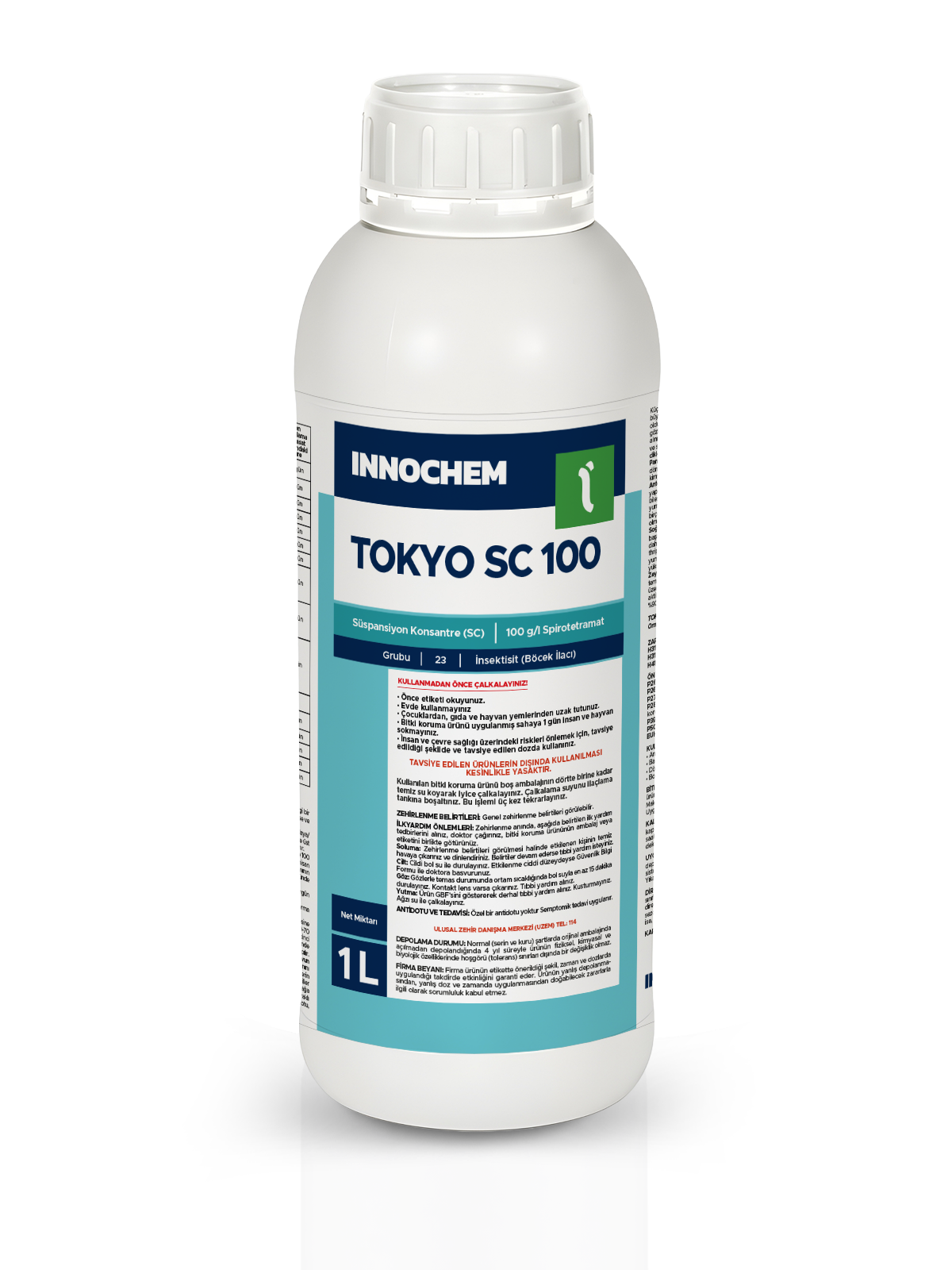
Tokyo 100 SC
Product Code: 13960
Category: Plant Protection
Product Group: INSECTICIDE
Active Ingredient: 100 g/L Spirotetramat
Formulation: Suspension Concentrate (SC)
Mode of Action Group: 23
General Information
- Toxic to bees. Do not use during flowering.
- Toxic to fish. Do not contaminate groundwater or surface water.
- In case of spillage, cover with sawdust or soil, then sweep up and dispose of properly.
- Do not use empty product packaging for any other purpose.
Do not allow people or animals into the treated area for 1 day.
Storage: When stored unopened in its original packaging under normal (cool and dry) conditions, the physical, chemical and biological properties of the product remain within tolerance limits for 4 years.
Preparation for application: First mix the plant protection product, calculated according to the recommended dose, with some water in a separate container. Fill the sprayer tank half full with water. With the agitator running, add the mixture to the tank. Continue mixing while topping up the tank with water. Keep agitating until the application is completed. Use the prepared mixture on the same day.
Calibration: The sprayer must be calibrated before application. The spray volume applied to a given area should be adjusted to ensure good coverage. Applications should be made during the cool hours of the day in calm or light-wind conditions. Under greenhouse conditions, 60-100 litres of water per decare may be used.
Cleaning the sprayer: Immediately after application, empty the sprayer tank safely. Fill the tank with clean water and run the agitator and spray system to rinse all parts. Do not wash equipment near water sources. Do not discharge rinse water or waste into water sources.
Compatibility: Mixing TOKYO SC 100 with other plant protection products is not recommended.
“Always read the label and product information before use”
“Use plant protection products carefully”
Vineyard – Vine mealybug: From May onwards, treatment is applied if any biological stage of the pest is seen in observations of the tissue under the bark. If observations show new egg masses and larvae and that the pest population is increasing, a second application should be made.
Tomato (Greenhouse), Pepper (Greenhouse), Eggplant (Greenhouse) – Tobacco whitefly: Enter the field/greenhouse found to be infested with whitefly diagonally. On large-leaved plants such as eggplant and squash, collect leaves from the lower, middle and upper parts every 5 steps, 50 leaves in total. Chemical control is applied when there are 5 larvae + pupae per leaf.
Pear – Pear psylla: Against the eggs of overwintering-generation adults, spraying is done when at least 10 eggs per 100 shoots are seen in checks from March onwards. Although it varies by region, spraying is done when, in shoot checks in March-April, almost all eggs laid by overwintering adults have hatched, second- and third-instar nymphs begin to appear and more than 15% of shoots are infested. A shoot is considered infested when one individual is seen on it.
Apple – Green apple aphid: During the growing season (generally in nurseries), treatment should start when 15 infested shoots per 100 shoots are seen.
Peach, Nectarine – Green peach aphid: From the appearance of flower buds until ¾ of the population has turned into the winged form, treatment should start when 7 infested branches are seen on 50 trees.
Peach, Nectarine – White peach scale: Where densities are very high (crusting), winter control may be used. If autumn and winter were cold and wet, winter control reduces the population by only 50-70%. In mild winters, over 90% efficacy is achieved. Summer control is applied against the first or second generation. However, in the second generation, it should be borne in mind that some peach varieties will have reached harvest. Applications start at the first larval emergence, and a second spray is made taking into account the duration of action of the product.
Aphids on vegetables (Tomato (Potato aphid), Lettuce (Green peach aphid, Cotton/melon aphid, Currant-lettuce aphid), Watermelon (Cotton/melon aphid)): To determine application timing, from April onwards walk diagonally across the field and, every 3-5 steps, randomly pick one leaf from young leaves and shoots. Based on counts with a hand lens on 25-50 leaves of legumes and 20-40 leaves of large-leaved plants such as eggplant, cucurbits and cabbage, control must start if there are 10-20 pests per leaf. Among leafy vegetables, 10-20 plants per 100-1000 m² are examined for large-leaved lettuce and spinach, and 50 plants per 100-1000 m² for small-leaved parsley, rocket, cress, dill, mint, basil and purslane. Treatment is applied when there are 10 individuals per plant on small-leaved plants (mint, parsley, etc.) and 20 individuals per leaf on large-leaved lettuce, spinach, etc. In addition, parasitoids and predators should be observed and the effectiveness of beneficials considered before deciding on treatment. The aphid population is strongly dependent on weather conditions; it drops suddenly when drought and temperature increase. This should be considered in applications.
Cotton – Cotton aphid: Chemical control is recommended when 25 adults+nymphs per plant are seen at the seedling stage, 110 at the squaring stage and 150 at the early boll stage.
Pistachio – Pistachio psylla: From mid-May onwards, a single application is sufficient when, in weekly counts on 100 compound leaves, an average of 20-30 nymphs per compound leaf is seen, a marked increase in the number of first summer adults and eggs is recorded, most of the laid eggs have hatched and the first adult parasitoids have not yet emerged.
Onion, Leek – Onion thrips: In the middle stages of plant development, an average of 30 thrips per plant is the control threshold. This figure is lower for young plants and rises as plants get older. With more than 50 thrips per plant, plant growth is inhibited and onion bulbs are smaller. Well-maintained and well-irrigated onions tolerate high populations.
Olive – Black scale: In orchards to be treated, egg-bearing females of the current year on 20-25 cm shoots on all 4 sides of a representative number of trees are checked to detect the emergence of active crawlers. The first application is made when 50% of the eggs have hatched and the second when 90% have hatched.
Resistance information: TOKYO SC 100 is an insecticide classified as Group 23 according to its mode of action. Repeated applications of plant protection products with the same mode of action promote the development of resistance. Therefore, to delay resistance, do not exceed the total number of applications recommended for TOKYO SC 100 in the same growing season. Where repeated treatment is needed, use plant protection products with a different mode of action (other than Group 23).
Description
| Crop | Target Organism | Application Rate and Timing | Pre-Harvest Interval |
|---|---|---|---|
| *Grapevine | Vine mealybug (Planococcus ficus, Planococcus citri) | 100 ml/100 l water (nymph, adult) | 14 days |
| Tomato | Potato aphid (Macrosiphum euphorbiae) | 75 ml/da (nymph, adult) | 3 days |
| Tomato (Greenhouse) | Tobacco whitefly (Bemisia tabaci) | 100 ml/100 l water (larva, pupa) | 3 days |
| Pepper (Greenhouse) | Tobacco whitefly (Bemisia tabaci) | 100 ml/100 l water (larva, pupa) | 3 days |
| Eggplant (Greenhouse) | Tobacco whitefly (Bemisia tabaci) | 100 ml/100 l water (larva, pupa) | 3 days |
| Pear | Pear psylla (Cacopsylla pyri) | 100 ml/100 l water (nymph, adult) | 21 days |
| Apple | Green apple aphid (Aphis Pomi) | 50 ml/100 l water (nymph, adult) | 21 days |
| Peach | Green peach aphid (Myzus persicae) | 75 ml/100 l water (nymph, adult) | 21 days |
| White peach scale (Pseudaulacaspis pentagona) | |||
| Nectarine | Green peach aphid (Myzus persicae) | 75 ml/100 l water (nymph, adult) | 21 days |
| White peach scale (Pseudaulacaspis pentagona) | |||
| Lettuce | Green peach aphid (Myzus persicae) | 75 ml/da (nymph, adult) | 7 days |
| Cotton/melon aphid (Aphis gossypii) | |||
| Currant-lettuce aphid (Nasonovia ribisnigri) | |||
| Cotton | Cotton/melon aphid (Aphis gossypii) | 100 ml/da (nymph, adult) | - |
| Watermelon | Cotton/melon aphid (Aphis gossypii) | 75 ml/da (nymph, adult) | 3 days |
| Pistachio | Pistachio psylla (Agonoscena pistaciae) | 100 ml/100 l water (nymph) | 14 days |
| Onion | Onion thrips (Thrips tabaci) | 100 ml/da (nymph, adult) | 3 days |
| Leek | Onion thrips (Thrips tabaci) | 100 ml/da (nymph, adult) | 3 days |
| Olive | Black scale (Saissetia oleae) | 75 ml/100 l water | 14 days |
*Not to be used in vineyards where vine leaves are harvested for consumption.