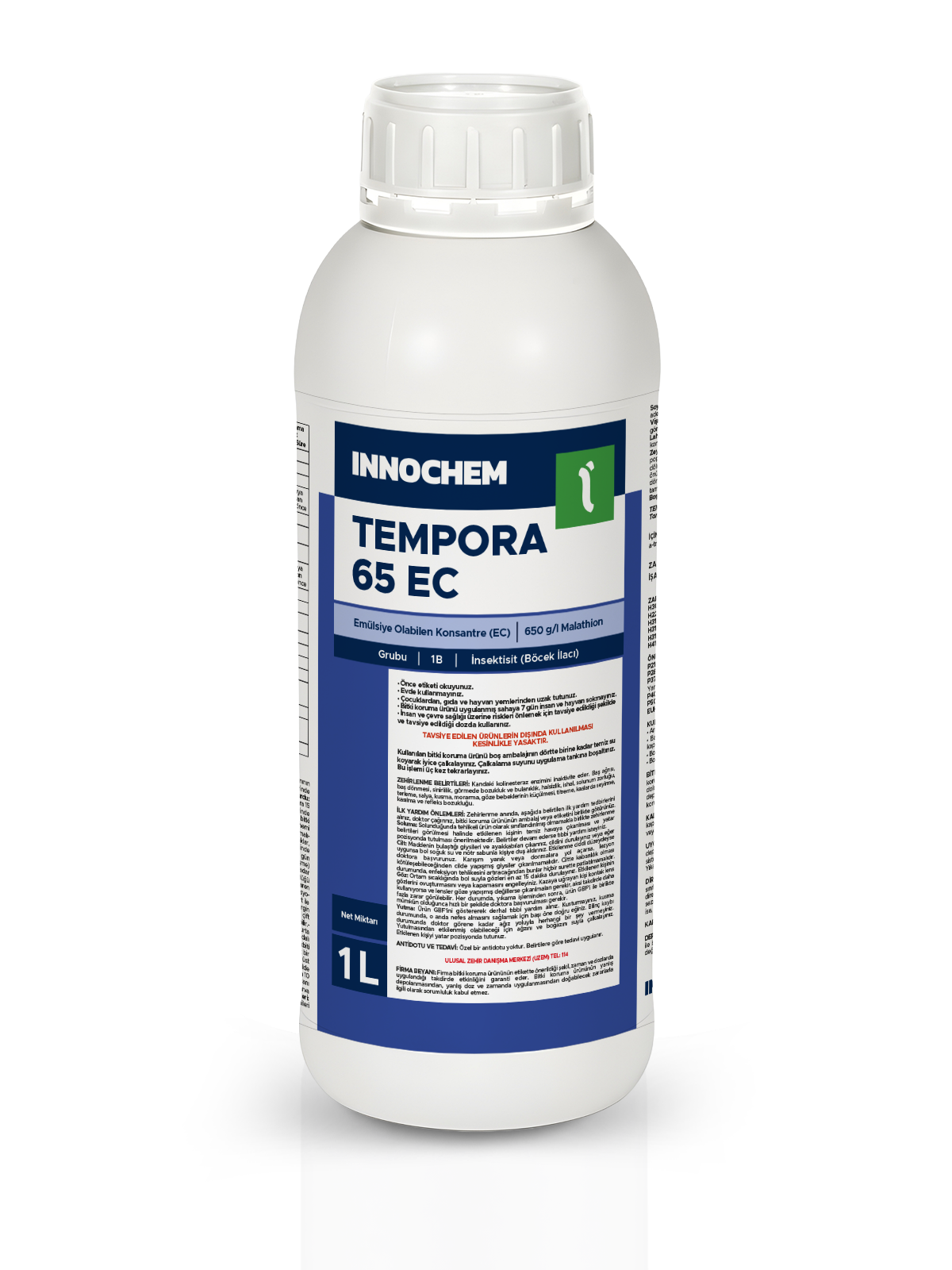
Tempora 65 EC
Product Code: 13439
Category: Plant Protection
Product Group: INSECTICIDE
Active Ingredient: 650 g/L Malathion
Formulation: Emulsifiable Concentrate (EC)
Mode of Action Group: 1B
General Information
- Toxic to bees. Do not use during flowering.
- Toxic to fish; avoid contaminating groundwater and surface water. Keep the plant protection product closed in its packaging.
- Never use empty packaging for any other purpose and dispose of it properly.
- Do not put plant protection products into empty food or drink containers.
Do not allow people or animals into the treated area for 7 days.
Storage: When stored unopened in its original packaging under normal (cool and dry) conditions, the physical, chemical and biological properties of the plant protection product remain within tolerance limits for 2 years.
Preparation for application: First mix the plant protection product, calculated according to the recommended dose, with some water in a separate container. Fill the sprayer tank half full with water. With the agitator running, add the mixture to the tank. Continue mixing while topping up the tank with water. Keep agitating until the application is completed. The prepared spray mixture must be used on the same day.
Calibration: The sprayer must be calibrated before application. The spray volume should be adjusted to ensure good coverage. Applications should be made during the cool hours of the day in calm or light-wind conditions. The spray volume for peach is 50-200 l/da
Cleaning the sprayer: Immediately after application, empty the sprayer tank safely. Fill the tank with clean water and run the agitator and spray system to rinse all parts. Do not wash equipment near water sources. Do not discharge rinse water or waste into water sources.
Compatibility: Mixing TEMPORA 65 EC with other plant protection products is not recommended.
“Always read the label and product information before use”
“Use plant protection products carefully”
Tomato – Cotton bollworm: When the first adults are seen, walk diagonally across the production area and, depending on its size, check 50-100 plants for eggs and larvae on flowers, leaves, stems, fruits and shoots. Treatment is applied if 5 out of 100 plants are infested.
Bean – Pod borer: The first application is made at the beginning of flowering; if moth flights continue, a second application is made 15 days after the first.
Maize – Cotton leafworm: At the 2-4 and 4-6 leaf stages, larvae are counted on a total of 25 plants (5 adjacent plants in a row at 5 points representative of the field). Treatment is applied when there is an average of 2 larvae per plant. Control can be carried out until the end of the early whorl stage. The product should be applied as a foliar spray during the cool hours of the day.
Apricot, Peach, Nectarine – Peach twig borer: Sex pheromone traps, accumulated effective temperatures and plant phenology are used to determine application timing. Larvae found on shoots are reared in cages in the orchard, and treatment is applied 10 days after the first moth emergence is seen or the first adult is caught in pheromone traps. At this time the fruit is phenologically at the colour-change (veraison) stage. If necessary, repeat at 10-day intervals. Applications should be made up to 15-20 days before harvest.
Vineyard – Citrus mealybug: Treatment is made when the mealybugs move onto the clusters and the grapes begin to accumulate sugar. Although it varies by region and variety, observations are made from the second half of June and treatment is applied when larvae are most abundant. If the pest population increases during the season, the application is repeated, taking into account the duration of action.
Opium poppy – Poppy root weevil: Between March and mid-April, treatment should be made when adult emergence from the soil peaks and at least 10 adults per m² are seen, before egg laying. At this time the poppy plant has 4-6 pairs of leaves. If adult density persists, a second application may be made depending on the duration of action of the product.
Cotton – Cotton leafworm: Treatment is applied when 10 larvae or 2 newly hatched egg masses per 100 plants are found during inspections.
Cotton – Aphids: If beneficial insects are abundant along with the aphids during field inspections, treatment should be postponed. Spraying is recommended if an increase in the aphid population is detected in later counts.
Cotton – Leafhoppers: For surveys, a 50 da cotton field is divided into 4 sections. In each section, leafhoppers are counted on 25 leaves, one leaf each taken from the lower, middle and upper part of the main stem of randomly selected plants. In this way the average number of pests per leaf is found from a total of 100 leaves for the whole area. Spraying should be done when an average of 10 leafhoppers per leaf is found.
Sesame – Sesame leaf roller: Chemical control is applied when 20% of plants are infested.
Soybean – Cotton leafworm: Control should start when 6 larvae or 2 newly hatched egg masses are found per 3 m of row.
Ornamental plants – Aphids: Treatment starts when aphid colonies begin to appear on the shoots and the undersides of young leaves on 20 out of 100 shoots counted.
Soybean – Southern green stink bug: Chemical control is applied when an average of 8 adults + nymphs are found per 3 m of row.
Cherry, Sour cherry – Cherry fruit fly: Treatment is made within one week at the latest after the first adult is seen on yellow sticky traps.
Cabbage – Large white butterfly: After moth flights are seen, plants are inspected; control should be carried out if infestation reaches 10%.
Olive – Olive scale: Spraying should not be done against the 1st generation of the pest except at very high populations. For the second generation, pest density and the parasitism rate in the orchard should be taken into account. Spraying is done when 50% of the eggs have hatched and first-instar larvae predominate, wetting all leaves and fruits. One spray is sufficient.
In empty storage facilities: Apply so as to wet all surfaces.
Resistance information: TEMPORA 65 EC is an insecticide classified as Group 1B according to its mode of action. Repeated applications of plant protection products with the same mode of action promote the development of resistance. Therefore, to delay resistance, do not exceed the total number of applications recommended for TEMPORA 65 EC in the same growing season. Where repeated treatment is needed, use plant protection products with a different mode of action (other than Group 1B).
Description
| Crop | Target Organism | Application Rate and Timing | Pre-Harvest Interval |
|---|---|---|---|
| Tomato | Cotton bollworm (Helicoverpa armigera) | 200 ml/da Larva | 7 days |
| Bean | Bean pod borer (Etiella zinckenella) | 200 ml/da Larva | 7 days |
| Maize | Cotton leafworm (Spodoptera exiqua) | 200 ml/da Larva | 7 days |
| Empty Store Treatment | Stored maize pests | 200 ml per 100 m² as an empty-store treatment | 20-25 days before the produce is placed in store |
| Apricot | Peach twig borer (Anarsia lineatella) | 150 ml/100 l water Larva | 14 days |
| Grapevine* | Citrus mealybug (Planococcus citri) | 150 ml/100 l water All stages | 7 days |
| Opium poppy | Poppy root weevil (Ceuthorrhynchus denticulatus) | 200 ml/100 l water Adult | 7 days |
| Empty Store Treatment | Stored cereals and cereal products (...) | 200 ml per 100 m² as an empty-store treatment | 20-25 days before the produce is placed in store |
| Cotton | Cotton leafworm (Spodoptera exiqua) | 250 ml/da Larva | 7 days |
| Cotton aphid (Aphis gossypii) | 100 ml/da Nymph, Adult | 7 days | |
| Leafhoppers (Asymmetrasca decedens, Empoasca decipiens) | 170 ml/da Nymph, Adult | 7 days | |
| Sesame | Sesame leaf roller (Antigastra catalaunalis) | 100 ml/da Larva | 7 days |
| Soybean | Cotton leafworm (Spodoptera exiqua) | 250 ml/da Larva | 7 days |
| Southern green stink bug (Nezara viridula) | 170 ml/da Nymph, Adult | 7 days | |
| Ornamental Plants | Aphids (Aphis sp.) | 85 ml/100 l water Nymph, Adult | - |
| Cherry | Cherry fruit fly (Rhagoletis cerasi) | 100 ml/100 l water Adult | 7 days |
| Sour cherry | |||
| Cabbage | Large white butterfly (Pieris brassicae) | 170 ml/da Larva | 7 days |
| Peach | Peach twig borer (Anarsia lineatella) | 150 ml/100 l water Larva | 7 days |
| Nectarine | |||
| Olive | Olive scale (Parlatoria oleae) | 150 ml/100 l water Larva | 7 days |
*Not to be used in vineyards where vine leaves are harvested for consumption.