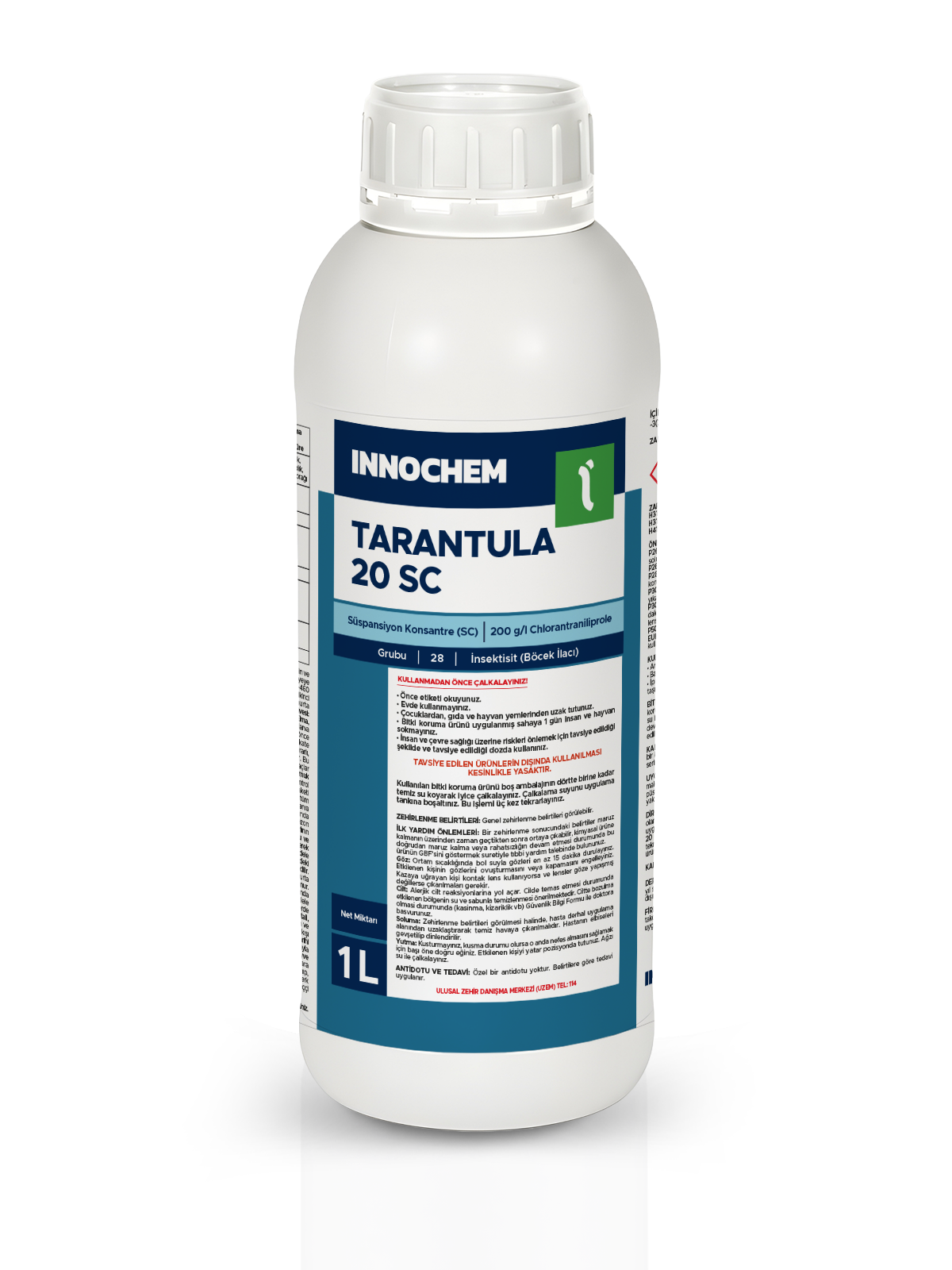
Tarantula 20 SC
Product Code: 13508
Category: Plant Protection
Product Group: INSECTICIDE
Active Ingredient: 200 g/L Chlorantraniliprole
Formulation: Suspension Concentrate (SC)
Mode of Action Group: 28
General Information
- Toxic to bees. Do not use during flowering.
- Toxic to fish; avoid contaminating groundwater and surface water.
- As it affects silkworms, prevent the product from drifting onto nearby mulberry trees during application.
- SHAKE BEFORE USE!
Do not allow people or animals into the treated area for 1 day.
Storage: When stored unopened in its original packaging under normal (cool and dry) conditions, the physical, chemical and biological properties of the plant protection product remain within tolerance limits for 2 years.
Preparation for application: First mix the plant protection product, calculated according to the recommended dose, with some water in a separate container. Fill the sprayer tank half full with water. With the agitator running, add the mixture to the tank. Continue mixing while topping up the tank with water. Keep agitating until the application is completed. Use the prepared mixture on the same day.
Calibration: The sprayer must be calibrated before application. The spray volume applied to a given area must ensure good coverage. Applications should be made during the cool hours of the day in calm or light-wind conditions.
Cleaning the sprayer: Immediately after application, empty the sprayer tank safely. Fill the tank with clean water and run the agitator and spray system to rinse all parts. Do not wash equipment near water sources. Do not discharge rinse water or waste into water sources.
Compatibility: Mixing with other plant protection products is not recommended.
“Always read the label and product information before use”
“Use plant protection products carefully”
Vineyard – European grapevine moth: Application timing is determined according to the forecasting and warning system. The decision to treat is made before the first eggs are seen in the vineyard, when the number of moths caught in sex pheromone traps has not yet peaked and is still increasing, when accumulated effective temperatures reach 95-100 degree-days for the 1st generation, 450-460 degree-days for the 2nd generation and 970-980 degree-days for the 3rd generation, and when plant phenology is at the flower bud stage for the first generation, the unripe berry stage for the second and the beginning of sugar accumulation for the third. One application is made against each generation.
Apple, Pear – Leaf miner moth: Treatment is applied if there are 4 or more live larvae per leaf and the parasitism rate is very low.
Apple, Pear, Quince – Codling moth: Applications are made according to the forecasting and warning system. The best effect is achieved by keeping the trees protected throughout the larval hatching period of each generation, killing the hatching larvae before they enter the fruit. In pear and quince, the forecasting and early warning system is not taken into account. Considering the duration of action of the product, spraying against the 1st generation should be repeated after 14 days. If the pest reaches a density requiring treatment in the second and later generations, spraying should continue in the same way. These sprays should be made with products having different modes of action, following the rules given in the resistance section.
In apple, pear and quince, do not make more than 2 applications on the same site in one season.
Cotton leafworm: The leaves, squares, flowers and bolls of a total of 25 plants, one every 10-15 steps, are inspected. Treatment is decided when 0.5 larvae per plant, or 2 egg masses or 2 newly hatched egg masses per 25 plants, are seen.
Cotton – Cotton bollworm: All plants in a randomly selected 3 m length of row are inspected and the bollworm eggs and larvae counted; treatment is decided when an average of 2 larvae per 3 m of row is found.
Cotton – Spiny bollworm: Treatment should be applied when the field survey finds an average of 2 larvae or 4 eggs close to hatching per 3 m of cotton row.
In cotton, do not make more than 2 applications on the same site in one season.
Colorado potato beetle: For best effect, application should be made when the pest eggs hatch or when the first damage is seen on the plants.
Mediterranean corn borer and European corn borer: In first-crop maize, pest density is usually low and spraying is generally not needed. However, chemical control is applied if 5% or more of plants are infested. First crop: taking a 50-decare field as one unit and walking through the field in a zigzag, infestation (egg clusters or feeding damage on leaves, stalk, ear, tassel and silk) is determined on 100 plants. Second crop: taking a 50-decare field as one unit and walking in a zigzag, egg masses are checked and counted on 100 plants. Corn borer egg clusters are usually found on the underside of leaves. Taking the duration of action into account, 2 or 3 sprays should be made at 10- or 15-day intervals. Chemical control must never be applied to sweet corn intended for fresh consumption or to silage maize.
Maize – Cutworm: In fields where the pest is likely to occur, spraying is carried out where at least 2 damaged plants are found along 3 m lengths of row at 10 different places in row-sown areas.
Peach, Apricot, Plum – Peach twig borer: Application should be made during the egg-laying period, before the eggs hatch and before larvae enter the fruit. Treatment is applied as soon as the first larval damage is seen on the fruit or 10 days after the first adult emergence is observed. A second application may be made, taking into account the duration of action of the product used, new larval damage and the harvest date. Depending on pest density, the application should be repeated at 14-day intervals. Do not make more than 2 applications per season.
Peach, Apricot, Nectarine – Oriental fruit moth: Control should start when the first entries into shoots are seen. Applications start when accumulated effective temperatures reach 400 degree-days after the first adult is caught in traps, and a second application is made according to the duration of action of the product. Alternatively, control should start 15 days after shoots abandoned by fully developed first-generation larvae are seen, and, taking into account the duration of action of the product, 2 applications may be made on medium-late varieties and 3 on late varieties.
Resistance information: TARANTULA 20 SC is an insecticide classified as Group 28 according to its mode of action. Repeated applications of plant protection products with the same mode of action promote the development of resistance. Therefore, to delay resistance, do not exceed the total number of applications recommended for TARANTULA 20 SC in the same growing season. Where repeated treatment is needed, use plant protection products with a different mode of action (other than Group 28).
Description
| Crop | Target Organism | Application Rate and Timing | Pre-Harvest Interval |
|---|---|---|---|
| Grapevine | European grapevine moth (Lobesia botrana) | 15 ml/100 l water (egg) | 3 days table grapes, 28 days wine grapes, 7 days vine leaves |
| Apple, Pear | Leaf miner moth (Leucoptera scitella) | 17.5 ml/100 l water | 14 days |
| Codling moth (Cydia pomonella) | 12.5 ml/100 l water (egg) | ||
| Quince | Codling moth (Cydia pomonella) | 12.5 ml/100 l water (egg) | 14 days |
| Cotton | Cotton bollworm (Helicoverpa armigera) | 17.5 ml/da | 21 days |
| Cotton leafworm (Spodoptera littoralis) | |||
| Spiny bollworm (Earias insulana) | 20 ml/da | ||
| Potato | Colorado potato beetle (Leptinotarsa decemlineata) | 6 ml/da (larva) | 14 days |
| Maize | Mediterranean corn borer (Sesamia spp.) | 15 ml/da (at 15-day intervals 2-3 applications) | 14 days |
| European corn borer (Ostrinia nubilalis) | |||
| Cutworm (Agrotis ipsilon, Agrotis segetum) | 15 ml/da | ||
| Peach, Apricot, Nectarine | Peach twig borer (Anarsia lineatella) | 20 ml/100 l water | 14 days |
| Oriental fruit moth (Cydia molesta) | 17.5 ml/100 l water | ||
| Plum | Peach twig borer (Anarsia lineatella) | 20 ml/100 l water | 14 days |