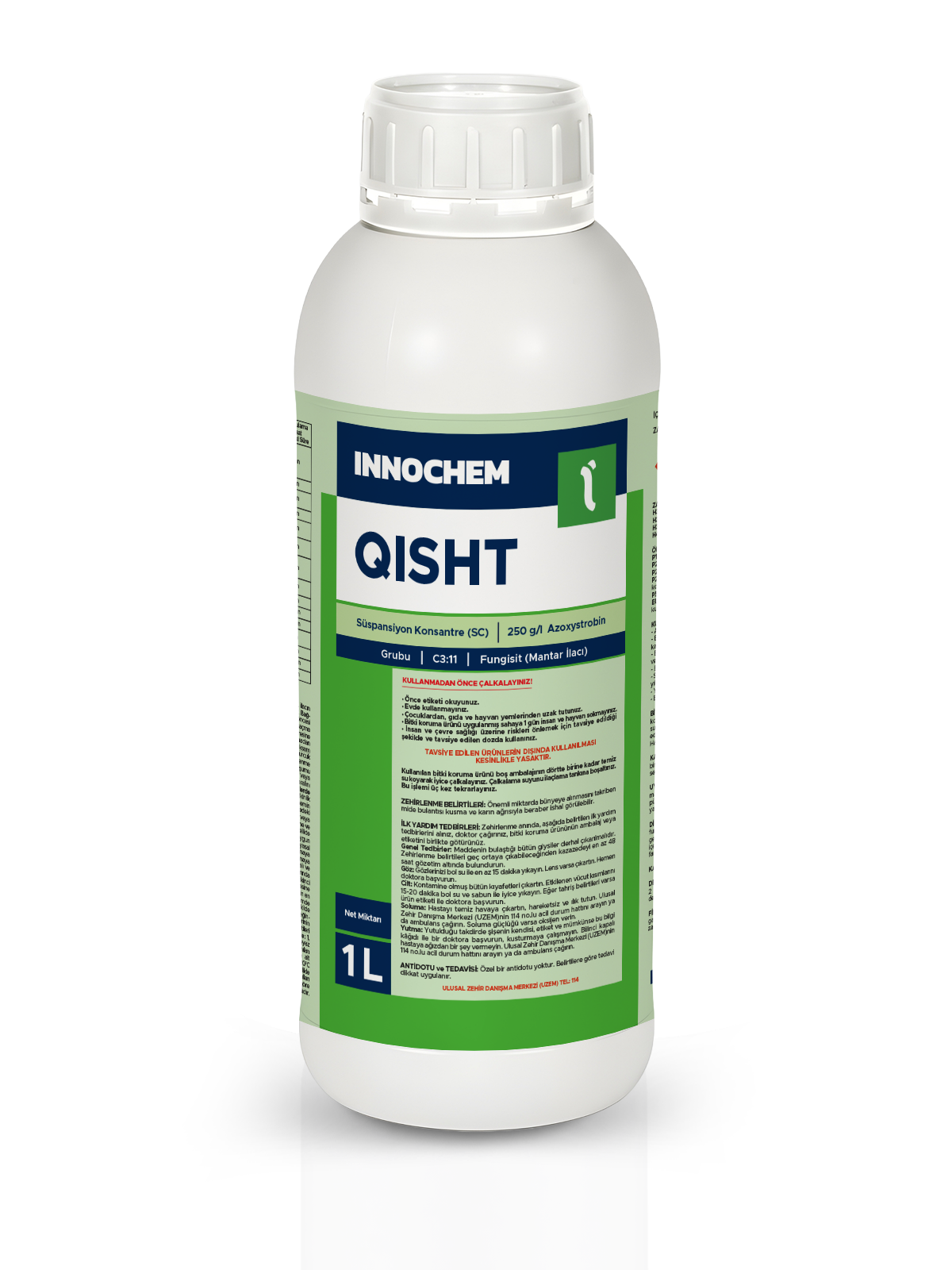
Qisht
Product Code: 12912
Category: Plant Protection
Product Group: FUNGICIDE
Active Ingredient: 250 g/L Azoxystrobin
Formulation: Suspension Concentrate (SC)
Mode of Action Group: C3:11
General Information
- Toxic to bees. Do not use during flowering.
- Toxic to fish; avoid contaminating groundwater and surface water.
- When disposing of plant protection product residues, do not contaminate still or running water sources used for irrigation or drinking.
- Keep the plant protection product closed in its original packaging.
- Undiluted QISHT may irritate the eyes and skin. In case of contact, wash eyes and skin immediately.
- Animals must not graze on recently treated areas, and no feed or food should be collected there.
- Never use empty packaging for any other purpose; dispose of it properly
- SHAKE WELL BEFORE USE.
Do not allow people or animals into the treated area for 1 day.
Storage: When stored unopened in the original packaging under normal (cool and dry) conditions, the physical, chemical and biological properties of the product remain within tolerance limits for 2 years.
Preparation for application: First mix the plant protection product, calculated according to the recommended dose, with some water in a separate container. Fill the sprayer tank half full with water. With the agitator running, add the mixture to the tank. Continue mixing while topping up the tank with water. Keep agitating until the application is completed. Use the prepared spray mixture on the same day.
Calibration: The sprayer must be calibrated before application. The spray volume applied to a given area must ensure good coverage. Applications should be made during the cool hours of the day in calm or light-wind conditions. The spray volume for vineyards is 10-150 l/da.
Cleaning the sprayer: Immediately after application, empty the sprayer tank safely. Fill the tank with clean water and run the agitator and spray system to rinse all parts. Do not wash equipment near water sources. Do not discharge rinse water or waste into water sources.
Compatibility: Mixing QISHT with other plant protection products is not recommended.
“Always read the label and product information before use”
“Use plant protection products carefully”
Vineyard – Grapevine downy mildew: The first application should start when shoots reach 25-30 cm. The second and subsequent applications are made at 10-15 day intervals, taking into account the duration of action of the first treatment, disease development and meteorological factors.
Vineyard – Grapevine powdery mildew:
1st application: before flowering, when shoots are 25-30 cm,
2nd application: before flowering, when the flower buds separate,
3rd application: when the petals have fallen and the berries are the size of small shot pellets,
4th and further applications: made according to the duration of action of the product used after the third application, until veraison.
Vineyard – Dead arm (Phomopsis cane and leaf spot):
Dormant-season application: The dormant-season application is made after pruning, 3-4 weeks before bud break.
Foliar application: Carried out during the growing season according to the following programme.
1st application: at the beginning of bud break,
2nd application: when shoots reach 8-10 cm in length,
3rd application: immediately before flowering (when flower clusters appear),
4th application: should be made at the end of flowering / beginning of fruit set.
Cucumber, Gherkin – Cucurbit downy mildew: Applications start when the plants begin to run or when the first downy mildew symptoms appear; depending on disease severity, applications must cover all parts of the plant, especially the undersides of the leaves.
Cucumber, Gherkin and Squash – Cucurbit powdery mildew:
Applications start when the first disease symptoms appear. Applications should continue depending on disease severity, weather conditions and the duration of action of the product. Applications should be suspended when the average daily temperature is above 27 °C and relative humidity is below 50%.
Tomato – Late blight: Control starts when 3-5 mm brown spots with a white, ash-like coating underneath are seen on tomato leaves in the area, or, where the disease occurs every year, when conditions favourable to the disease arise. Applications continue at 10-12 day intervals depending on disease progress and weather conditions.
Tomato – Early blight: Applications should start as soon as the first spots appear, both in the nursery and in the field. When weather conditions favour disease development, the application should be repeated according to the duration of action of the product.
Watermelon – Alternaria leaf blight: Chemical control is applied as foliar treatments. Applications should start when the first symptoms are seen in the area. Applications continue at 10-12 day intervals, taking into account disease severity, weather conditions and the duration of action of the product.
Pepper (Greenhouse) – Powdery mildew: Applications should start when the first disease symptoms appear on the plants and, if necessary, continue at 10-12 day intervals.
Rice – Rice blast: In foliar applications, treatment should be made as soon as the disease is first seen. Where necessary, second and third applications should be made taking into account the duration of action of the product used.
Wheat – Septoria leaf blotch: If weather conditions favour disease development and an epidemic is likely, a foliar application is made. In general, the best time for application is the end of the booting stage, when the flag leaf is fully unfolded, or before ear emergence. In the case of an early infection climbing towards the upper parts of the plant, do not wait for the flag leaf to emerge. Likewise, if the field is infected and rainy weather continues during heading, an application may be needed as economic damage may occur. Where repeated application is required, the duration of action stated on the product labels must be taken into account.
Strawberry – Strawberry anthracnose: Applications should start when the first disease symptoms appear. The 2nd application should be made 10 days after the first.
Pear – Pear scab:
1st application: when flower buds swell (in areas with branch canker, 3-5 days earlier)
2nd application: at the white bud (rosette) stage,
3rd application: when 70-80% of the petals have fallen,
4th and further applications: should be made taking into account the duration of action of the fungicides used.
Wheat – Yellow (stripe) rust: Early symptoms of the disease on the lower leaves may be seen every year. Therefore, disease progress should be monitored in view of weather conditions (90% relative humidity and 15-20 °C), and when the disease advances towards the top of the plant, foliar spraying should start to prevent infection of the upper leaves, especially the flag leaf. If weather conditions favour disease development and an epidemic is likely, spraying may be repeated according to the duration of action of the product used.
Citrus – Brown spot: Sprays should be made before or after harvest. For pre-harvest applications, the interval between the last spray and harvest must be observed.
Resistance information: QISHT is a fungicide classified as Group C3:11 according to its mode of action. Repeated applications of plant protection products with the same mode of action promote the development of resistance. Therefore, to delay resistance, do not exceed the total number of applications recommended for QISHT in the same growing season. Where repeated treatment is needed, use plant protection products with a different mode of action (other than Group C3:11).
Description
| Crop | Target Organism | Application Rate | Pre-Harvest Interval |
|---|---|---|---|
| *Grapevine | Grapevine downy mildew (Plasmopara viticola) | 75 ml/100 l water | 21 days |
| Grapevine powdery mildew (Erysiphe necator) | |||
| Dead arm (Phomopsis) (Phomopsis viticola) | |||
| Cucumber | Cucurbit downy mildew (Pseudoperonospora cubensis) | 60 ml/100 l water | 3 days |
| Cucurbit powdery mildew (Erysiphe cichoracearum, Podosphaera xanthii) | 75 ml/100 l water | 3 days | |
| Gherkin | Cucurbit downy mildew (Pseudoperonospora cubensis) | 60 ml/100 l water | 3 days |
| Cucurbit powdery mildew (Erysiphe cichoracearum, Podosphaera xanthii) | 75 ml/100 l water | 3 days | |
| Squash | Cucurbit powdery mildew (Erysiphe cichoracearum, Podosphaera xanthii) | 75 ml/100 l water | 3 days |
| Tomato (Field) | Late blight (Phytophthora infestans) | 75 ml/100 l water | 3 days |
| Early blight (Alternaria solani) | |||
| Watermelon | Alternaria leaf blight of watermelon (Alternaria cucumerina) | 75 ml/da | 3 days |
| Pepper (Sera) | Powdery mildew of solanaceous crops (Leveillula taurica) | 75 ml/100 l water | 3 days |
| Rice | Rice blast (Pyricularia oryzae) | 100 ml/da | 28 days |
| Wheat | Septoria leaf blotch (Septoria tritici) | 100 ml/da | 56 days |
| Strawberry | Strawberry anthracnose (Colletotrichum fragariae, Colletotrichum gloesporioides, Colletotrichum aculatum) | 75 ml/da | 1 day |
| Pear | Pear scab (Venturia pirina) | 75 ml/100 L water | 7 days |
| Wheat | Yellow rust (Puccinia striiformis) | 100 ml/da | 56 days |
| Citrus | Brown spot (Alternaria alternata f.sp.citri) | 75 ml/100 l water | 21 days |
* Not to be used in areas where vine leaves are harvested for consumption.