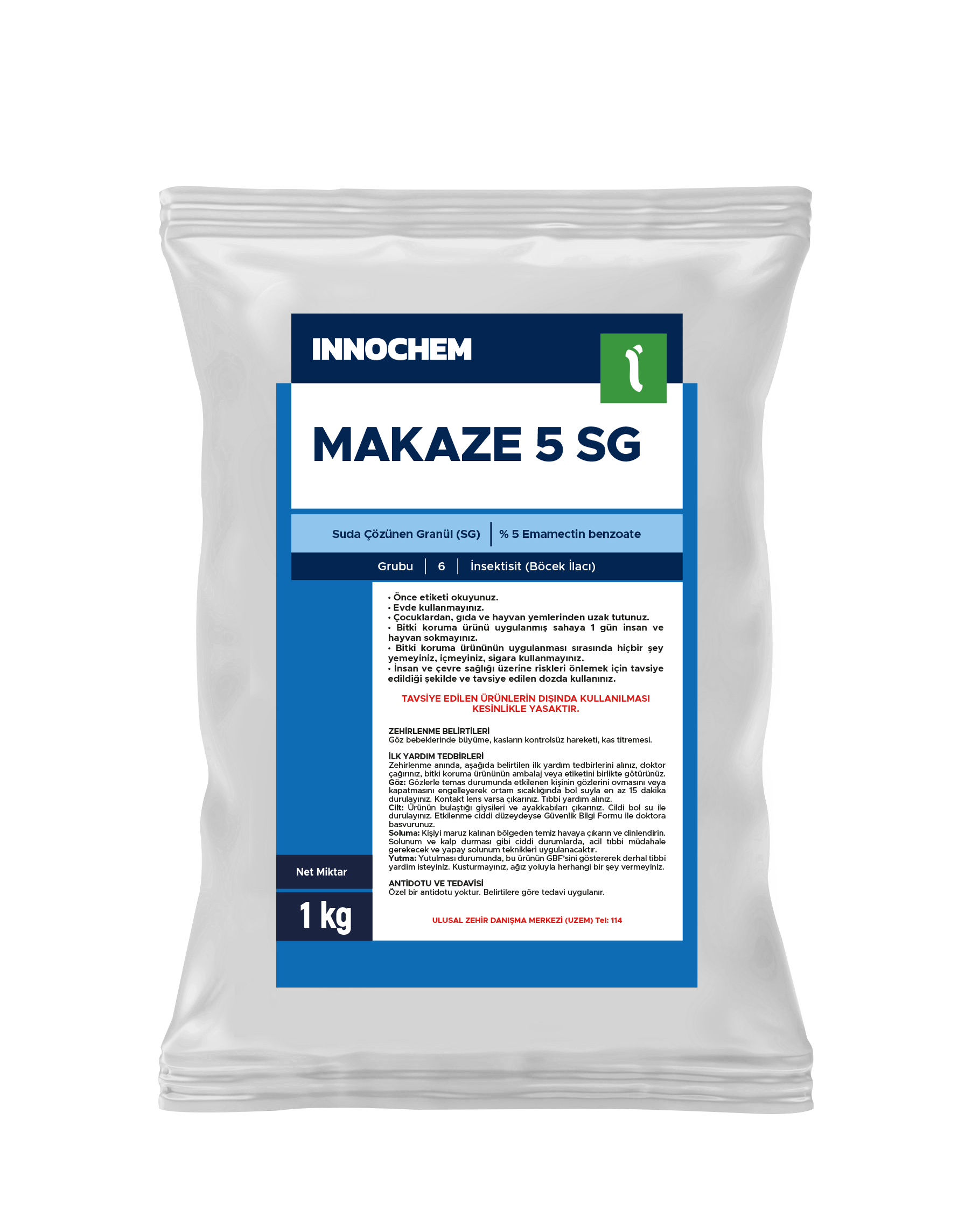
Makaze 5 SG
Product Code: 13854
Category: Plant Protection
Product Group: INSECTICIDE
Active Ingredient: 5% Emamectin benzoate
Formulation: Water-Soluble Granule (SG)
Mode of Action Group: 6
General Information
- Toxic to fish. Do not contaminate water sources, lakes or streams.
- Toxic to bees. Do not use during flowering.
- Keep the plant protection product in its packaging with the lid closed.
- Dispose of empty packaging properly.
- Never use empty packaging for any other purpose.
- Do not put plant protection products into empty food or drink packaging.
- Use a mask covering the mouth and nose.
- As with other pesticides, avoid contact with the product as far as possible.
Do not allow people or animals into the treated area for 1 day.
Storage: When stored unopened in its original packaging under normal (cool and dry) conditions, the physical, chemical and biological properties of the product remain within tolerance limits for 2 years.
Preparation for application: First mix the plant protection product, calculated according to the recommended dose, with some water in a separate container. Fill the sprayer tank half full with water. With the agitator running, add the mixture to the tank. Continue mixing while topping up the tank with water. Keep agitating until the application is completed. Use the prepared mixture on the same day.
Calibration: The sprayer must be calibrated before application. The spray volume applied to a given area must ensure good coverage. Applications should be made during the cool hours of the day in calm or light-wind conditions. The spray volume for tomato (greenhouse) is 2-3 l/da.
Cleaning the sprayer: Immediately after application, empty the sprayer tank safely. Fill the tank with clean water and run the agitator and spray system to rinse all parts. Do not wash equipment near water sources. Do not discharge rinse water or waste into water sources.
Compatibility: Mixing MAKAZE 5 SG with other plant protection products is not recommended.
“Always read the label and product information before use”
“Use plant protection products carefully”
Tomato (Greenhouse), Tomato (Field), Pepper (Greenhouse) – Cotton bollworm: To detect adult emergence, sex pheromone traps are used in the field (1-2 traps/ha) and in the greenhouse (1 trap/greenhouse) immediately after transplanting. Traps are checked weekly; when the first adult is seen in a trap, walk diagonally across the production area and, depending on its size, check 50-100 plants for eggs and larvae on flowers, leaves, stems, fruits and shoots. If 5 out of 100 plants are infested, control starts immediately.
Pepper (Greenhouse-Field), Cucumber (Greenhouse), Gherkin (Greenhouse), Eggplant (Greenhouse) – Cotton leafworm: Walking diagonally across vegetable plots, control is decided when 1-2 newly hatched egg masses or 4-5 larvae are seen per 100 plants. Spraying should be done before the larvae on the leaves disperse.
Vineyard – European grapevine moth: Sprays against the grapevine moth are directed by the forecasting and warning system. Spraying is carried out following the first larval hatch from the eggs, when the number of moths caught in sex pheromone traps peaks and starts to fall, when evening temperatures exceed 15 °C on two days and remain so in the 1st generation, when accumulated effective temperatures reach 20 dd (degree-days) in the 1st generation, 520 dd in the 2nd and 1047 dd in the 3rd, and when the vine is phenologically at the flower bud stage in the 1st generation, the unripe berry stage in the 2nd and the beginning of sugar accumulation in the 3rd. One spray is made per generation. However, as egg laying may continue from the 3rd generation onwards, spraying continues as long as new eggs are found, taking into account the duration of action of the product and the harvest date.
Vineyard – Thrips: In spring, when the buds begin to break and the first leaves appear in the vineyard, treatment should be made when the pest population density reaches at least 2-3 thrips adults or larvae per leaflet. Care should be taken to treat all green parts of the vine. One application is sufficient.
Cotton – Cotton bollworm: Against cotton bollworm in cotton, all plants in a randomly selected 3 m length of row are inspected and bollworm eggs and larvae are counted; treatment is decided when an average of 2 larvae per 3 m of row is found.
Cotton – Cotton leafworm: To determine spraying time, a 50-decare cotton field is taken as one unit. The leaves, squares, flowers and bolls of a total of 25 plants, one every 10-15 steps, are inspected. Treatment is decided when 0.5 larvae per plant, or 2 egg masses or 2 newly hatched egg masses per 25 plants, are seen. Spraying should be done when the larvae have just hatched and before they disperse.
Olive – Jasmine moth: Treatment starts once a population has developed and 1st and 2nd instar larvae predominate.
Carnation – Cotton bollworm: Treatment starts when 5 out of 100 plants are infested.
Carnation – Cotton leafworm: Control should start when 5-6 larvae or 1 egg mass are found in a 3 m length of row. For good results, spraying should target 1st-3rd instar larvae. Sufficient results cannot be expected from spraying against older larvae.
Apple – Codling moth: Applications against codling moth should be guided by the forecasting and early warning system. The aim in codling moth control is to keep the trees protected throughout the larval hatching period of each generation so that hatching larvae are killed before they enter the fruit.
Pomegranate – Carob moth: At the end of June / beginning of July, when the fruits reach about 3-5 cm in diameter and infestation exceeds 5%, 4-5 sprays are made at 10-15 day intervals depending on the duration of action of the product.
Resistance information: MAKAZE 5 SG is an insecticide classified as Group 6 according to its mode of action. Repeated applications of plant protection products with the same mode of action promote the development of resistance. Therefore, to delay resistance, do not exceed the total number of applications recommended for MAKAZE 5 SG in the same growing season. Where repeated treatment is needed, use plant protection products with a different mode of action (other than Group 6).
Description
| Crop | Target Organism | Application Rate and Timing | Pre-Harvest Interval |
|---|---|---|---|
| Tomato (Greenhouse) | Cotton bollworm (Helicoverpa armigera) | 30 g/100 l water Larva | 7 days |
| Tomato (field) | Cotton bollworm (Helicoverpa armigera) | 30 g/da larva | 7 days |
| Pepper (Greenhouse) | Cotton leafworm (Spodoptera littoralis) | 30 g/100 l water Larva | 7 days |
| Cotton bollworm (Helicoverpa armigera) | 30 g/100 l water Larva | 7 days | |
| Pepper (Field) | Cotton leafworm (Spodoptera littoralis) | 30 g/100 l water Larva | 7 days |
| *Grapevine | European grapevine moth (Lobesia botrana) | 25 g/100 l water Larva | 28 days |
| Grapevine thrips (Rubiothrips vitis, Mycterothrips albidicornis, Mycterothrips tschirkunae, Thrips tabaci) | 50 g/100 l water Adult-Larva (Grapes and Leaves) | ||
| Cotton | Cotton bollworm (Helicoverpa armigera) | 40 g/da Larva | 21 days |
| Cotton leafworm (Spodoptera littoralis) | 35g/da Larva | 21 days | |
| Olive | Jasmine moth (Palpita unionalis) | 30 g/100 l water Larva | 28 days |
| Carnation | Cotton bollworm (Helicoverpa armigera) | 30 g/100 l water Larva | - |
| Cotton leafworm (Spodoptera littoralis) | 30 g/100 l water Larva | - | |
| Cucumber (Greenhouse) | Cotton leafworm (Spodoptera littoralis) | 30 g/100 l water Larva | 14 days |
| Gherkin (Greenhouse) | Cotton leafworm (Spodoptera littoralis) | 30 g/100 l water Larva | 14 days |
| Apple | Codling moth (Cydia pomonella) | 20 g/100 l water Larva | 14 days |
| Eggplant (Greenhouse) | Cotton leafworm (Spodoptera littoralis) | 30 g/100 l water Larva | 7 days |
| Nar | Carob moth (Ectomyelois ceratoniae) | 30 g/100 L water (Larva) | 28 days |
*Not to be used in vineyards where vine leaves are harvested for consumption.