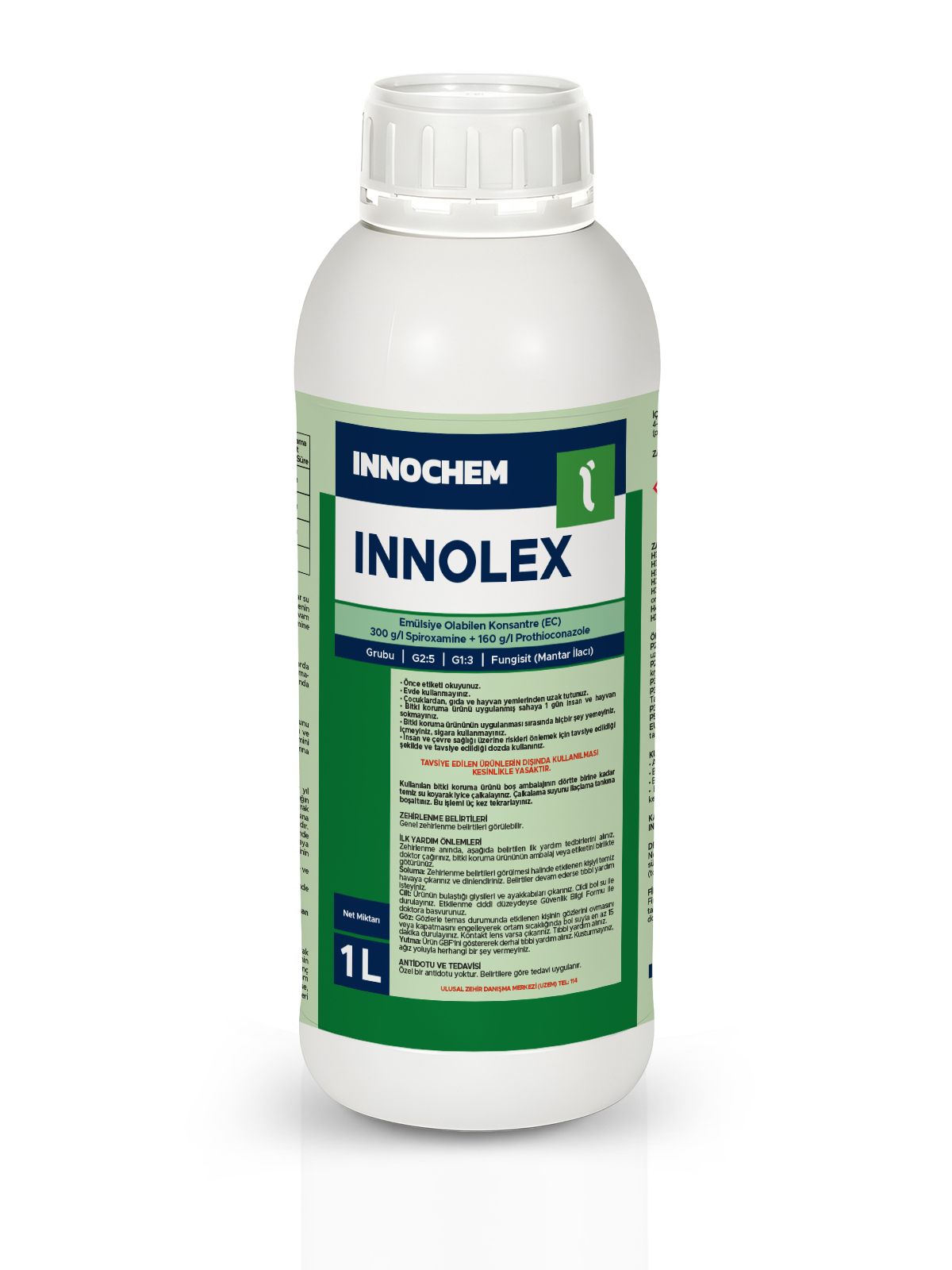
Innolex
Product Code: 14179
Category: Plant Protection
Product Group: FUNGICIDE
Active Ingredient: 300 g/L Spiroxamine + 160 g/L Prothioconazole
Formulation: Emulsifiable Concentrate (EC)
Mode of Action Group: G2:5, G1:3
General Information
- Toxic to bees; do not use during flowering.
- Toxic to fish; do not contaminate groundwater or surface water.
- Keep the plant protection product closed in its original packaging.
- Store empty packaging properly and never use it for any other purpose.
Do not allow people or animals into the treated area for 1 day.
Storage: When stored unopened in its original packaging under normal (cool and dry) conditions, the physical, chemical and biological properties of the plant protection product remain within tolerance limits for 2 years.
Preparation for application: First mix the plant protection product, calculated according to the recommended dose, with some water in a separate container. Fill the sprayer tank half full with water. With the agitator running, add the mixture to the tank. Continue mixing while topping up the tank with water. Keep agitating until the application is completed. The prepared spray mixture must be used on the same day.
Calibration: The sprayer must be calibrated before application. The spray volume applied to a given area must ensure good coverage. Applications should be made during the cool hours of the day in calm or light-wind conditions. The spray volume for wheat is 5-15 l/da.
Cleaning the sprayer: Immediately after application, empty the sprayer tank safely. Fill the tank with clean water and run the agitator and spray system to rinse all parts. Do not wash equipment near water sources. Do not discharge rinse water or waste into water sources.
Compatibility: Mixing INNOLEX with other plant protection products is not recommended.
“Always read the label and product information before use”
“Use plant protection products carefully”
Wheat – Cereal powdery mildew: Powdery mildew symptoms may appear every year under suitable conditions. Therefore, disease progress should be monitored in view of weather conditions, and when the disease advances towards the top of the plant, foliar spraying should start to prevent infection of the upper leaves, especially the flag leaf. Seed treatment should be carried out before sowing with one of the seed treatment products.
Wheat – Septoria leaf blotch: Likewise, if the field is infected and rainy weather continues during heading, spraying may be needed as economic damage may occur. Where repeated spraying is required, the duration of action stated on the product labels must be taken into account.
Wheat – Barley – Root and crown rot: Foliar spraying should be carried out between tillering and the flag leaf stage.
Barley – Barley leaf scald: Foliar spraying should be carried out when the first symptoms of the disease appear.
Resistance information: INNOLEX is a fungicide classified as Groups G2:5 and G1:3 according to its mode of action. Repeated applications of plant protection products with the same mode of action promote the development of resistance. Therefore, to delay resistance, do not exceed the total number of applications recommended for INNOLEX in the same growing season. Where repeated treatment is needed, use plant protection products with a different mode of action (other than Groups G2:5 and G1:3).
Description
| Crop | Target Organism | Application Rate and Timing | Pre-Harvest Interval |
|---|---|---|---|
| Wheat | Cereal powdery mildew (Erysiphe graminis) | 100 ml/da | 35 days |
| Septoria leaf blotch (Septoria tritici) | 100 ml/da | 35 days | |
| Wheat – Barley | Root and crown rot ((Fusarium spp., -Rhizoctonia spp.)) | 100 ml/da | 35 days |
| Barley | Barley leaf scald (Rhynchosporium secalis) | 100 ml/da | 35 days |