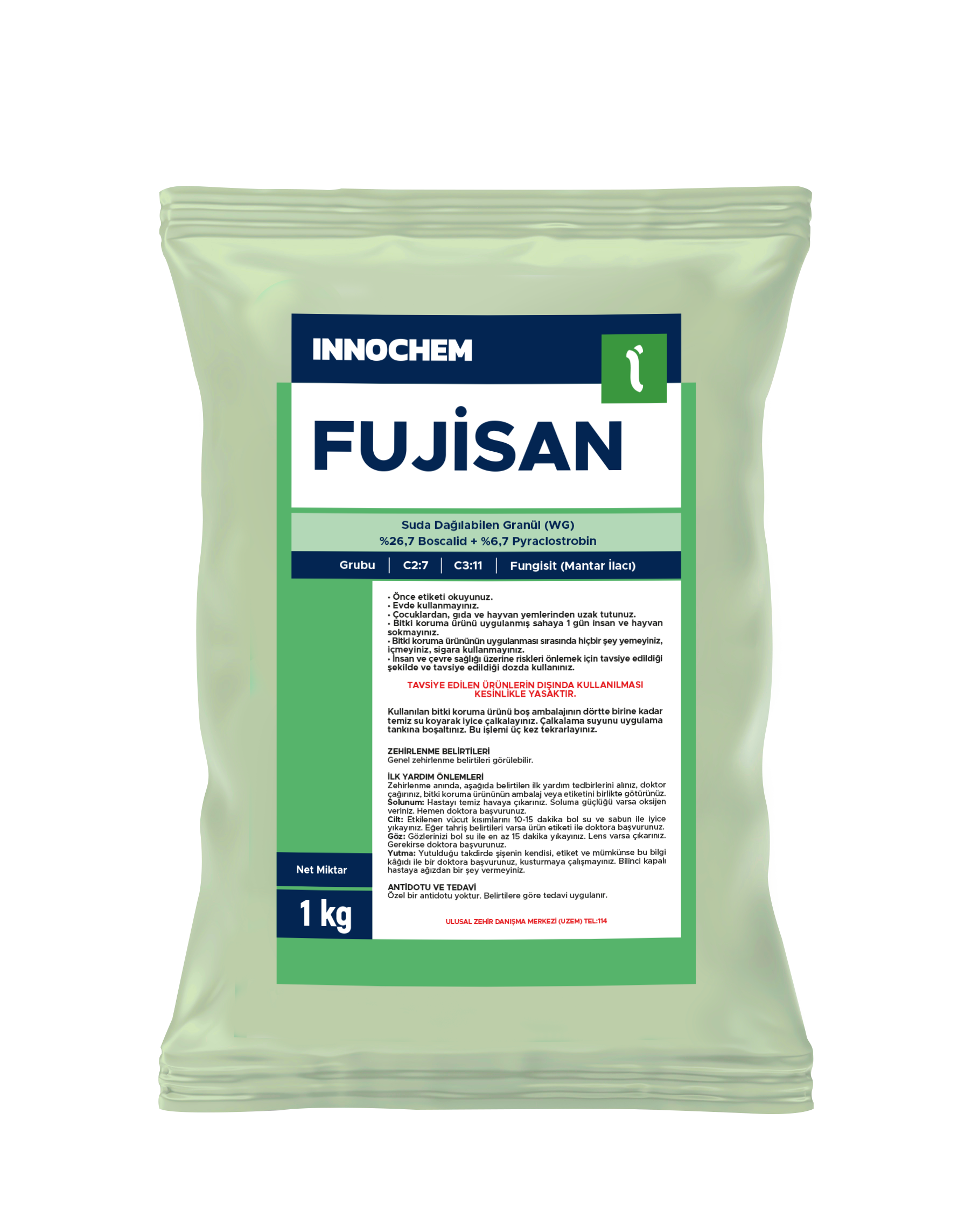
Fujisan
Product Code: 14202
Category: Plant Protection
Product Group: FUNGICIDE
Active Ingredient: 26.7% Boscalid + 6.7% Pyraclostrobin
Formulation: Water-Dispersible Granule (WG)
Mode of Action Group: C2:7, C3:11
General Information
- Toxic to bees. Do not use during flowering.
- Toxic to fish; avoid contaminating groundwater and surface water.
- Keep the plant protection product closed in its original packaging.
- Never use empty packaging for any other purpose and dispose of it properly.
- Do not put plant protection products into empty food or drink containers.
Do not allow people or animals into the treated area for 1 day.
Storage: When stored unopened in its original packaging under normal (cool and dry) conditions, the physical, chemical and biological properties of the plant protection product remain within tolerance limits for 4 years.
Preparation for application: First mix the plant protection product, calculated according to the recommended dose, with some water in a separate container. Fill the sprayer tank half full with water. With the agitator running, add the mixture to the tank. Continue mixing while topping up the tank with water. Keep agitating until the application is completed. The prepared spray mixture must be used on the same day.
Calibration: The sprayer must be calibrated before application. The spray volume should be adjusted to ensure good coverage. Applications should be made during the cool hours of the day in calm or light-wind conditions. The spray volume for grey mould on tomato is 30-60 l/da.
Cleaning the sprayer: Immediately after application, empty the sprayer tank safely. Fill the tank with clean water and run the agitator and spray system to rinse all parts. Do not wash equipment near water sources. Do not discharge rinse water or waste into water sources.
Compatibility: Mixing FUJİSAN with other plant protection products is not recommended
“Always read the label and product information before use”
“Use plant protection products carefully”
Tomato (Greenhouse), Eggplant (Greenhouse), Pepper (Greenhouse) – Grey mould: Spraying starts when the first symptoms of the disease are seen in the area. Repeat spraying should be decided according to ecological conditions and disease progress. A maximum of 3 applications should be made per season.
Tomato (Greenhouse - Field) – Powdery mildew of solanaceous crops: Applications should be made when the first disease symptoms appear in the field and greenhouse. Depending on disease progress and weather conditions, the application is repeated at 10-day intervals. It should be applied so as to cover all parts of the plants, when the weather is cool and calm.
Cucumber, Gherkin (Greenhouse) – White rot of vegetables: In areas known to be infested, soil application should start before planting and foliar application after transplanting the seedlings. A maximum of 2 applications should be made per growing season.
Strawberry – Grey mould:
1st application: when 10% of the first flowers have opened,
2nd application: when 50% of the flowers have opened,
3rd application: should be made when the first green fruits appear.
Watermelon – Alternaria leaf blight of cucurbits: Applications should start as soon as the first spots appear, both in the nursery and in the field. When weather conditions favour disease development, applications continue at 12-day intervals depending on disease progress and weather conditions.
Apricot, Cherry, Peach, Nectarine, Sour cherry – Blossom blight (Monilinia):
1st application: at the beginning of flowering (when 5-10% of flowers are open)
2nd application: should be made at full bloom (when 90-100% of flowers are open).
Potato – Early blight: Applications should start as soon as the first spots appear, both in the nursery and in the field. When weather conditions favour disease development, applications continue at 10-day intervals depending on disease progress and weather conditions.
Onion – Onion rust: Spraying is carried out as foliar spraying. Spraying should start as soon as rust pustules are seen on the leaves and continue at 10-day intervals depending on disease severity and weather conditions.
Carrot – Powdery mildew: Applications start when the first symptoms of the disease appear. Taking disease severity and weather conditions into account, applications continue at 10-day intervals. Apply so as to cover the green parts of the plant, when the weather is cool and windless.
Lettuce – White rot of vegetables: In areas known to be infested, soil application should start before planting and foliar application after transplanting the seedlings.
Turf areas – Soil-borne diseases: Spraying should be done when the first disease symptoms appear. It continues at 10-day intervals depending on ecological conditions and disease progress.
Carnation (Greenhouse) – Damping-off: Treatment is applied when the first disease symptoms appear. Second and further sprays are repeated at 10-day intervals depending on disease progress. Sprays are applied as a drench at the base of the seedlings.
If disease conditions persist in the area, spraying continues at 10-day intervals. A maximum of 3 applications should be made with the same product.
Resistance information: FUJİSAN is a fungicide classified as Group C2:7, C3:11 according to its mode of action. Repeated applications of plant protection products with the same mode of action promote the development of resistance. Therefore, to delay resistance, do not exceed the total number of applications recommended for FUJİSAN in the same growing season. Where repeated treatment is needed, use plant protection products with a different mode of action (other than Group C2:7, C3:11).
Description
| Crop | Target Organism | Application Rate | Pre-Harvest Interval |
|---|---|---|---|
| Tomato (Greenhouse) | Grey mould (Botrytis cinerea) | 150 g/100 l water | 3 days |
| Eggplant (Greenhouse) | Grey mould (Botrytis cinerea) | 150 g/100 l water | 3 days |
| Pepper (Sera) | Grey mould (Botrytis cinerea) | 150 g/100 l water | 3 days |
| Tomato (Greenhouse) | Powdery mildew of solanaceous crops (Leveillula taurica) | 60 g/100 l water | 3 days |
| Tomato (Field) | Powdery mildew of solanaceous crops (Leveillula taurica) | 100 g/da | 3 days |
| Cucumber, Gherkin (Greenhouse) | White rot of vegetables (Sclerotinia sclerotionum) | 150 g/100 l water | 3 days |
| Strawberry | Grey mould (Botrytis cinerea) | 150 g/100 l water | 3 days |
| Watermelon | Alternaria leaf blight of cucurbits (Alternaria cucumerina) | 100 g/da | 3 days |
| Apricot | Blossom blight (Monilinia laxa = Sclerotinia laxa) | 100 g/100 l water | 7 days |
| Peach, Nectarine | Blossom blight (Monilinia laxa = Sclerotinia laxa) | 75 g/100 l water | 14 days |
| Cherry, Sour cherry | Blossom blight (Monilinia laxa = Sclerotinia laxa) | 75 g/100 l water | 7 days |
| Potato | Early blight (Alternaria solani) | 100 g/da | 3 days |
| Onion | Onion rust (Puccinia porri) | 150 g/da | 7 days |
| Carrot | Powdery mildew (Erysiphe heraclei, Leveillula taurica) | 150 g/da | 1 day |
| Lettuce | White rot of vegetables (Sclerotinia sclerotiorum) | 150 g/da | 7 days |
| In turf areas | Soil-borne diseases (Fusarium spp., Rhizoctonia spp.) | 150 g/da | - |
| Carnation (Greenhouse) | Damping-off (Rhizoctonia spp.) | 150 g/100 l water | - |