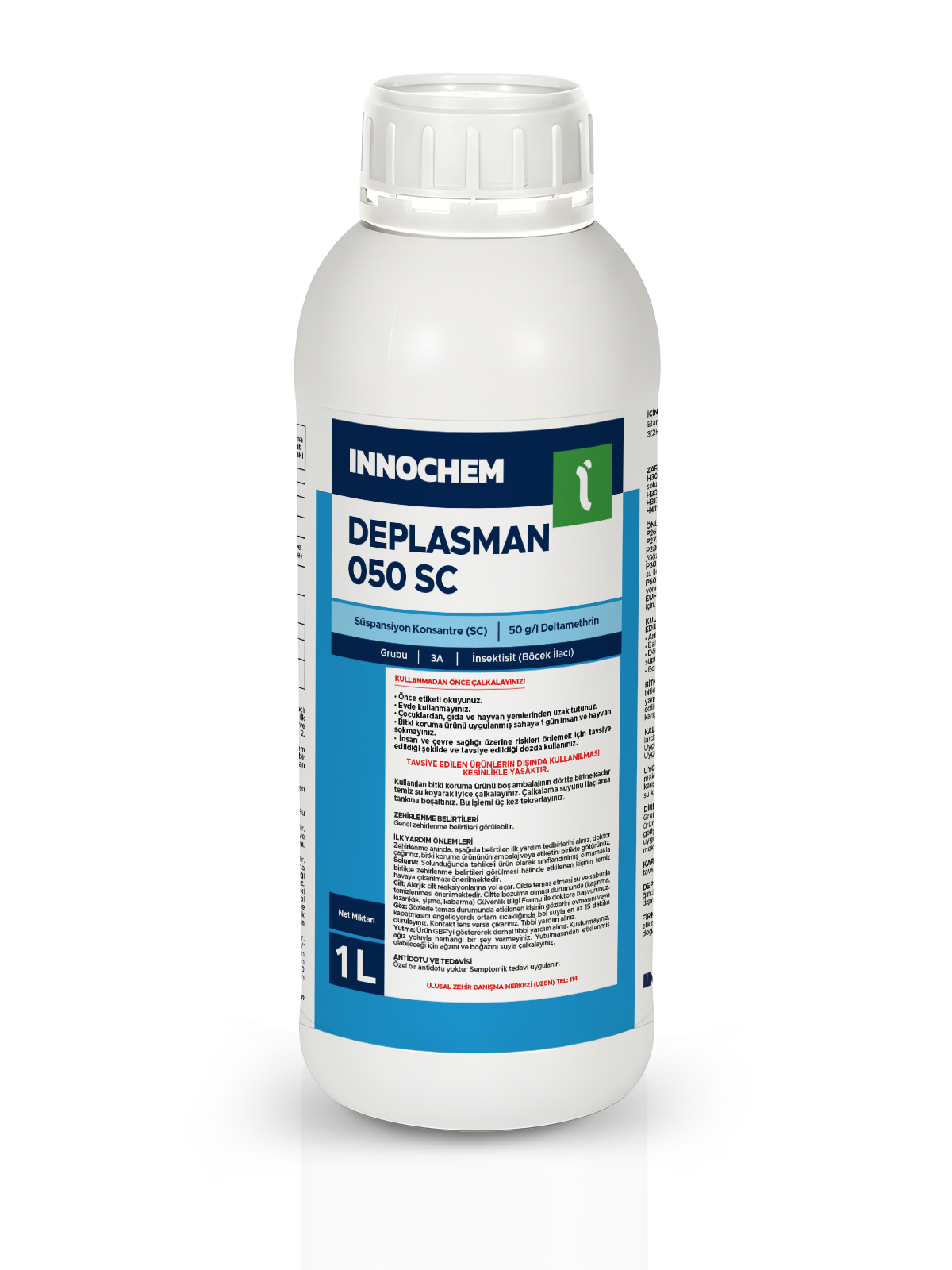
Deplasman 050 SC
Product Code: 14123
Category: Plant Protection
Product Group: INSECTICIDE
Active Ingredient: 50 g/L Deltamethrin
Formulation: Suspension Concentrate (SC)
Mode of Action Group: 3A
General Information
- Toxic to bees. Do not use during flowering.
- Toxic to fish. Do not contaminate groundwater or surface water.
- In case of spillage, cover with sawdust or soil, then sweep up and dispose of properly.
- Do not use empty product packaging for any other purpose.
- SHAKE BEFORE USE.
Do not allow people or animals into the treated area for 1 day.
Storage: When stored unopened in its original packaging under normal (cool and dry) conditions, the physical, chemical and biological properties of the product remain within tolerance limits for 2 years.
Preparation for application: First mix the plant protection product, calculated according to the recommended dose, with some water in a separate container. Fill the sprayer tank half full with water. With the agitator running, add the mixture to the tank. Continue mixing while topping up the tank with water. Keep agitating until the application is completed. Use the prepared mixture on the same day.
Calibration: The sprayer must be calibrated before application. The spray volume applied to a given area should be adjusted to ensure good coverage. Applications should be made during the cool hours of the day in calm or light-wind conditions. Under greenhouse conditions, 60-100 l of water per decare may be used.
Cleaning the sprayer: Immediately after application, empty the sprayer tank safely. Fill the tank with clean water and run the agitator and spray system to rinse all parts. Do not wash equipment near water sources. Do not discharge rinse water or waste into water sources.
Compatibility: Mixing DEPLASMAN 050 SC with other plant protection products is not recommended.
“Always read the label and product information before use”
“Use plant protection products carefully”
Apple – Codling moth: The aim of control is to keep the trees protected throughout the larval hatching period of each generation, killing the hatching larvae before they enter the fruit. The forecasting and warning method is used to accurately determine the first application dates for each generation and the pest density. After deciding to treat according to this method, a total of 3 applications should be made: 2 against the first generation and 1 against the second.
Cherry – Cherry fruit fly: Treatment should be made within one week at the latest after the first adult is seen, using “yellow sticky trap + ammonia capsule” or phenological observation. One application is usually sufficient. However, if flies continue to be caught in the traps after the first application, a second application may be made, taking into account the duration of action of the product and the harvest date.
Dried fruit pests: Treatment against dried fruit pests is carried out in 3 ways.
1- Empty store treatment: carried out after the necessary cultural measures have been taken and the store has been whitewashed with lime.
2- Fumigation: applied at the start of storage to produce that became infested before storage.
3- Full store treatment: applied if infestation is seen during storage. This treatment is made when 3-4 adult insects are seen in sticky traps or 10-15 in open traps.
Tobacco – Tobacco moth – Cigarette beetle: Should be carried out in empty stores after the store has been cleaned. The amount of water required per 100 m² should be calculated. Windows, doors and ventilation systems should be closed before application. The recommended amount of plant protection product per m² should be applied to all surfaces so that no dry spot remains.
Tobacco – Onion thrips: Treatment should be made when an average of 5 thrips per leaf is found.
Olive – Olive fruit fly: Taking regional differences into account, sting counts should be made when the fruits reach egg-laying maturity, and treatment should be applied if there are sufficient stings and an increase in the number of olive fly adults caught in traps. Sting counts are made 1-2 times a week on shiny fruits that have begun to accumulate oil
and fluorescent yellow in colour on the south-east side of the trees, to determine the sting percentage. For mass trapping and partial branch spraying, 400-500 fruits are checked, and for cover spraying 200 fruits, and the sting rate (%) is determined. As a result of the counts,
when 1% stings is found in table olive varieties and 3-4% stings in oil varieties, partial branch treatment or cover spraying should be carried out with ground equipment.
Olive – Olive moth: Treatment should preferably be applied only against the fruit generation of the pest. Treatment should be made if 10% of the lentil-sized olive fruits checked contain live “eggs+larvae”. The appropriate timing is determined by checks in the second half of May. However, if the pest causes more than 10% damage to leaves and new shoots at the start of the season, treatment should be made against the flower generation 7-10 days after the first moths are caught. Delta-type pheromone traps are used to determine treatment timing. These traps are hung in orchards in April and checked once a week.
Resistance information: DEPLASMAN 050 SC is an insecticide classified as Group 3A according to its mode of action. Repeated applications of plant protection products with the same mode of action promote the development of resistance. Therefore, to delay resistance, do not exceed the total number of applications recommended for DEPLASMAN 050 SC in the same growing season. Where repeated treatment is needed, use plant protection products with a different mode of action (other than Group 3A).
Description
| Crop | Target Organism | Application Rate and Timing | Pre-Harvest Interval |
|---|---|---|---|
| Apple | Codling moth (Cydia pomonella) | 7.50 ml/100 l water | 3 days |
| Cherry, Sour cherry | Cherry fruit fly (Rhagoletis cerasi) | 15 ml/100 l water | 3 days |
| Dried Figs | Saw-toothed grain beetle (Oryzaephilus surinamensis) | 30 ml/100 m2 (With a maximum of 5 l water) | 49 days |
| Raisins | Saw-toothed grain beetle (Oryzaephilus surinamensis) | 30 ml/100 m2 (With a maximum of 5 l water) | 49 days |
| Dried Fig and Raisin Stores | Saw-toothed grain beetle (Oryzaephilus surinamensis) | 30 ml/100 m2 (Empty store surface treatment) | 21 days (on wood and concrete surfaces) |
| Tobacco | Tobacco moth (Ephestia elutella) | 30 ml/100 m2 (with a maximum of 5 l water)-(Store) | 15 days |
| Cigarette beetle (Lasioderma serricorne) | 30 ml/100 m2 (with a maximum of 5 L water)-(Store) | 15 days | |
| Onion thrips (Thrips tabaci) | 30 ml/da | 14 days | |
| Olive | Olive fruit fly (Bactrocera oleae) | 12.5 ml/100 l water | 21 days |
| Olive moth (Prays oleae) | 15 ml/100 l water (Flower generation and Fruit generation) | 21 days |